Introduction to Sudoku
Sudoku is a number-placement puzzle played on a 9 × 9 grid. The goal is to fill the grid with the digits 1 through 9 so that each row, each column, and each 3 × 3 subgrid contains every digit exactly once. In other words, the finished grid must have no empty cells and no repeated digit in any row, column, or box.
Structure of a Sudoku
A small square where a digit can be placed is called a cell. A Sudoku grid contains 81 cells arranged in a 9 × 9 layout.
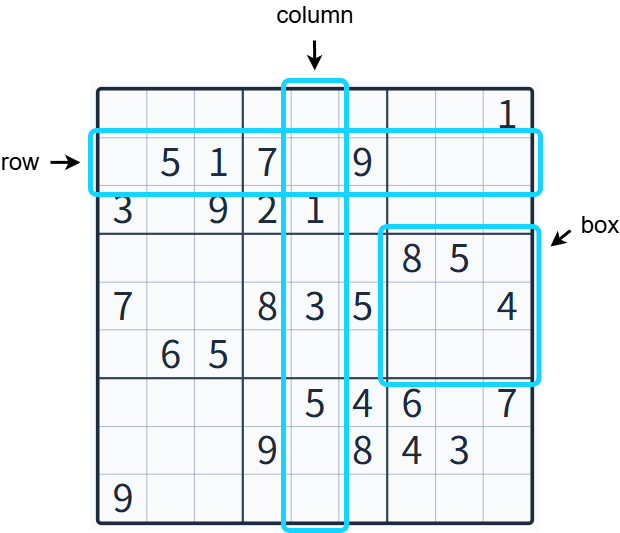
Each horizontal group of 9 cells is called a row. A Sudoku grid has 9 rows in total. They are numbered from top to bottom as 1 through 9, and are written as R1 to R9. For example, the row highlighted in the figure above is R2.
Each vertical group of 9 cells is called a column. A Sudoku grid has 9 columns in total. They are numbered from left to right as 1 through 9, and are written as C1 to C9. For example, the column highlighted in the figure above is C5.
Each 3 × 3 region is called a box. A Sudoku grid has 9 boxes in total. They are numbered from the top left to the bottom right as 1 through 9, and are written as B1 to B9. For example, the box highlighted in the figure above is B6.
Rows, columns, and boxes are collectively referred to as houses. Each row, column, or box is a house.
You can identify and refer to a cell by its row and column. For example, the highlighted cell in the grid below is R2C5, which means the cell at the intersection of row 2 and column 5.
Givens and Answers
A Sudoku puzzle usually starts with some digits already filled in. These are called given digits or givens. The player then fills the empty cells with answer digits or answers while always keeping the Sudoku rules satisfied. When every empty cell has been filled and the completed grid still follows all Sudoku rules, the puzzle is solved.
Candidates
While solving a puzzle, you cannot always determine the exact digit for a cell immediately. Often, several digits may still fit the current grid without violating the Sudoku rules, meaning the same digit does not already appear in any of that cell's houses: its row, column, or box. Of course, only one of those digits will eventually become the final answer, while the others will be ruled out as more cells are solved. A digit that has not yet been confirmed but does not currently violate the Sudoku rules is called a candidate.
When solving with software, candidates are often shown in a smaller size and a lighter color. When solving Sudoku in books or newspapers, people often mark candidates in cells with a pencil, so candidates are also called pencil marks, or simply notes.
In the grid below, every empty cell is annotated with its candidates. Take R2C5 as an example. Its candidates are 4, 6, and 8. This means that, in the current state of the grid, placing any of those three digits in cell R2C5 would still satisfy the Sudoku rules. This is because the digits 1, 2, 3, 5, 7, and 9 already appear in the three houses that contain R2C5, while 4, 6, and 8 do not.
Basic solving approach
When solving a Sudoku puzzle, the basic approach is usually to start with some kind of single technique and gradually fill in answer digits. When single techniques can no longer provide new answers, you then try various non-single techniques to eliminate some candidates from unfilled cells, and then return to single techniques to see whether more answer digits can now be placed.
If you choose to write candidates on the grid, then each time you fill in an answer digit, you should also remove that digit from the other cells in the same row, column, or box according to the Sudoku rules. This further simplifies the grid and makes it easier to apply new single or non-single techniques.